Which handwriting style should your child learn?
Teaching a child to write their name and first words is fun and easy, but before you get too far along, be aware that there are a variety of types of handwriting— they are called handwriting styles.
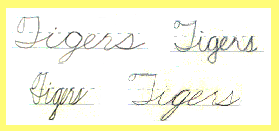
Four children wrote the word "Tiger." They were all taught the same handwriting style.
Ask Your Local School
Primary or elementary schools agree on one handwriting style to teach—at least they should. If your preschool child is eager to write or your child is already attending school, but you don't know which style is used, contact the local school office and ask.
Homeschooling
Homeschool parents—you get to decide! It's nice to find a style that appeals to each child, but I've found that it makes sense to stick to one style for the family.
The Left-Handed Child
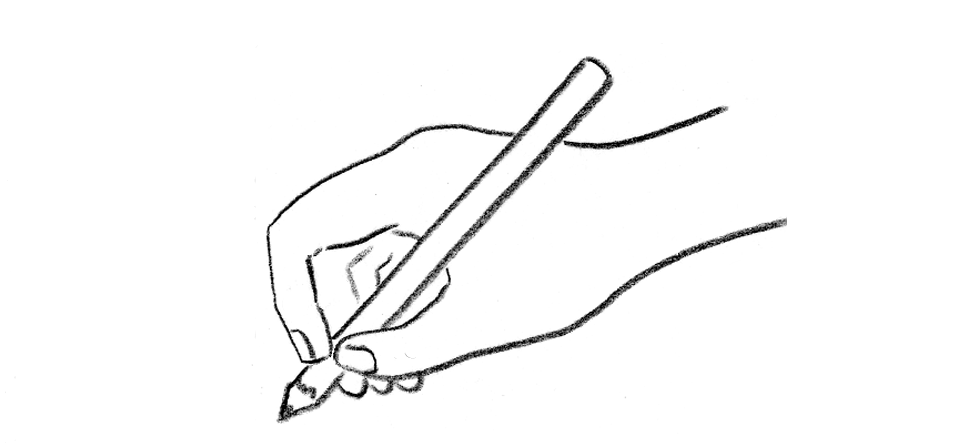
With any handwriting style, there is a slight modification that can help a left-handed child write more smoothly. It's simple—pull the pencil toward the hand when making horizontal lines. For example, a right-handed writer crosses the letter “t” from left to right. For the left-handed, the letter is crossed from right to left. The following letters are affected:
Lowercase letters: t, f
Capital letters: A, E, F, H, I, J, T.
Manuscript Only?
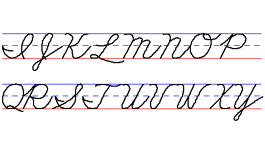
Handwriting styles are designed with a manuscript (print) and a cursive (linked) form. Progressing to the cursive or linked form is the goal, as it is the quicker or more fluid form of handwriting. Today, many children get handwriting instruction and practice for only a few years at best and may not get instruction in cursive. I encourage teachers and parents to include regular handwriting practice into sixth grade. Keep practice time short—ten to fifteen minutes. For older children, practice time may be only once a week.
Begin with Cursive?
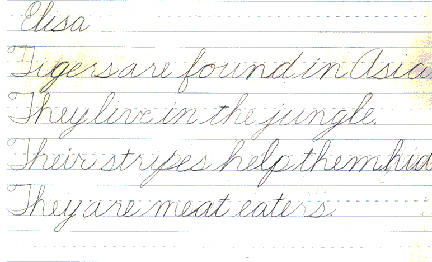
Yes, it is fine to start in cursive, and most children love it. When Marie was a child in the 1920’s, all her handwriting was in cursive. Manuscript was introduced later and used for labeling maps or posters.
A handwriting style is a carefully designed, efficient way of forming letters and numbers.
Each style has it’s own character or fits certain needs. There is no "correct" handwriting style—although publishers of handwriting programs or language arts programs might feel that theirs is the best! A handwriting chart or some other reference on how letters are formed (letter cards with the starting points and arrows, alphabet strips, iPad app) is a good reference tool to have available.

Simply be aware of letter formation and model it for your children or students. When given no instruction or example to follow, bright children can come up with some terribly awkward and cumbersome ways of making letters!
Oh, So Unique!
Whichever handwriting style or type is chosen, the personality of each child's handwriting is evident.
One child may space letters wide. Another might slant their letters less than the child sitting next to them. Some tend toward narrow lettering. Then, there are those who have a confident flow to their writing.
Our uniqueness shows in our handwriting. It is our style.
Training and Practice
Handwriting programs have instructions and books and gadgets and apps. For many people, it is not necessary or practical. The main thing is to help the child memorize the letter formation (there are many fun ways to do this) and have clear standards and expectations for their practice time.
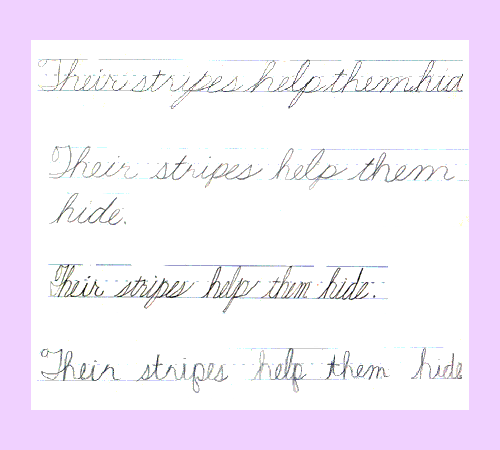
These first and second-grade children learned to write together. They each show an individual style, and all are beautiful. The papers are from the end of their school year.